
About Me
I am an Assistant Professor of Mathematics at Greensboro College in Greensboro, NC. I have a M.S. and PhD in Applied Mathematics from Lehigh University. I also earned a B.S. in Mathematics (with honors) and a B.A. in Music from Moravian College (now Moravian University). My primary research direction relates applied statistics to algorithmic music composition. My secondary research direction involves using probability theory to study optimal strategies for playing on TV game shows. In my spare time, I enjoy practicing piano and composing music.
Algorithmic Music Composition
I use Guided Markov Chains (GMC) in order to compose sequences of chords following the style of Bach chorales. This approach provides an improvement over existing models such as the standard Markov chain (SMC) because it allows the composer direct control over the phrase lengths and the sentiment of the music at each chord. This model also provides an improvement over neural networks which are complicated to modify if the composer wishes to change his/her compositional preferences to reflect a different style of music. I have shown that GMC models increase the likelihood of observing a given sequence of chords Bach used when compared with the SMC. I have also shown that using a guiding variable in a Markov chain exponentially reduces the number of typical sequences of chords.
In order to generate chord progressions using the GMC, the composer must first specify a sequence of harmonic functions appropriate for tonal music (i.e. tonic, dominant, tension, etc.). Using the transition matrix for roman numeral chords that I have constructed, the roman numeral chord at each step is chosen from only those roman numeral chords with the correct harmonic function (provided by the composer) at the given step. The transitions probabilities of these selected roman numerals are rescaled to a probability distribution from which the next roman numeral is randomly sampled. Figure 1 below shows the results of a simulation where the GMC was provided a periodic sequence of harmonic functions and asked to generate 200 chord progressions following this guide. I plot the average cumulative log-likelihood (scored by the GMC) of the 200 sequences over the course of the music. For comparison, all sequences are also scored by a standard (unguided Markov chain) and a Hidden Markov model (HMM) Viterbi-trained on Bach chorales with hidden states representing the same harmonic functions that guide the GMC. Clearly, the GMC has the best average cumulative log-likelihood out of all three models as it leverages provided knowledge about the guide as well as information on chord transitions from the transition matrix. This demonstrates that knowing the harmonic functions of the roman numeral chords provides an improvement over the unguided first-order structure of the SMC and the functional modeling of the HMM.
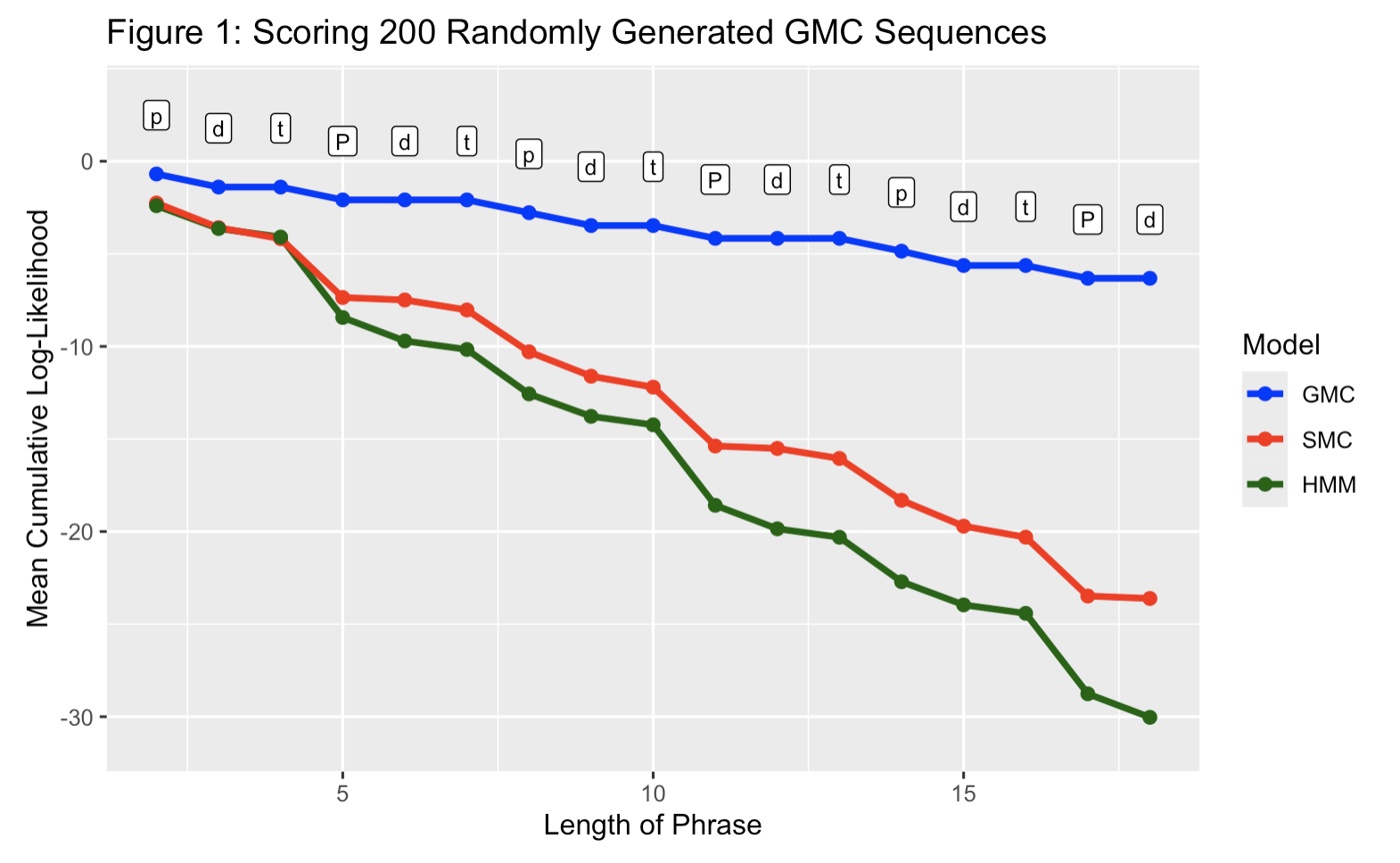
Figure 1: GMC Simulation
I also show that the GMC maintains its superior performance to the other models even when scoring progressions generated by the SMC.
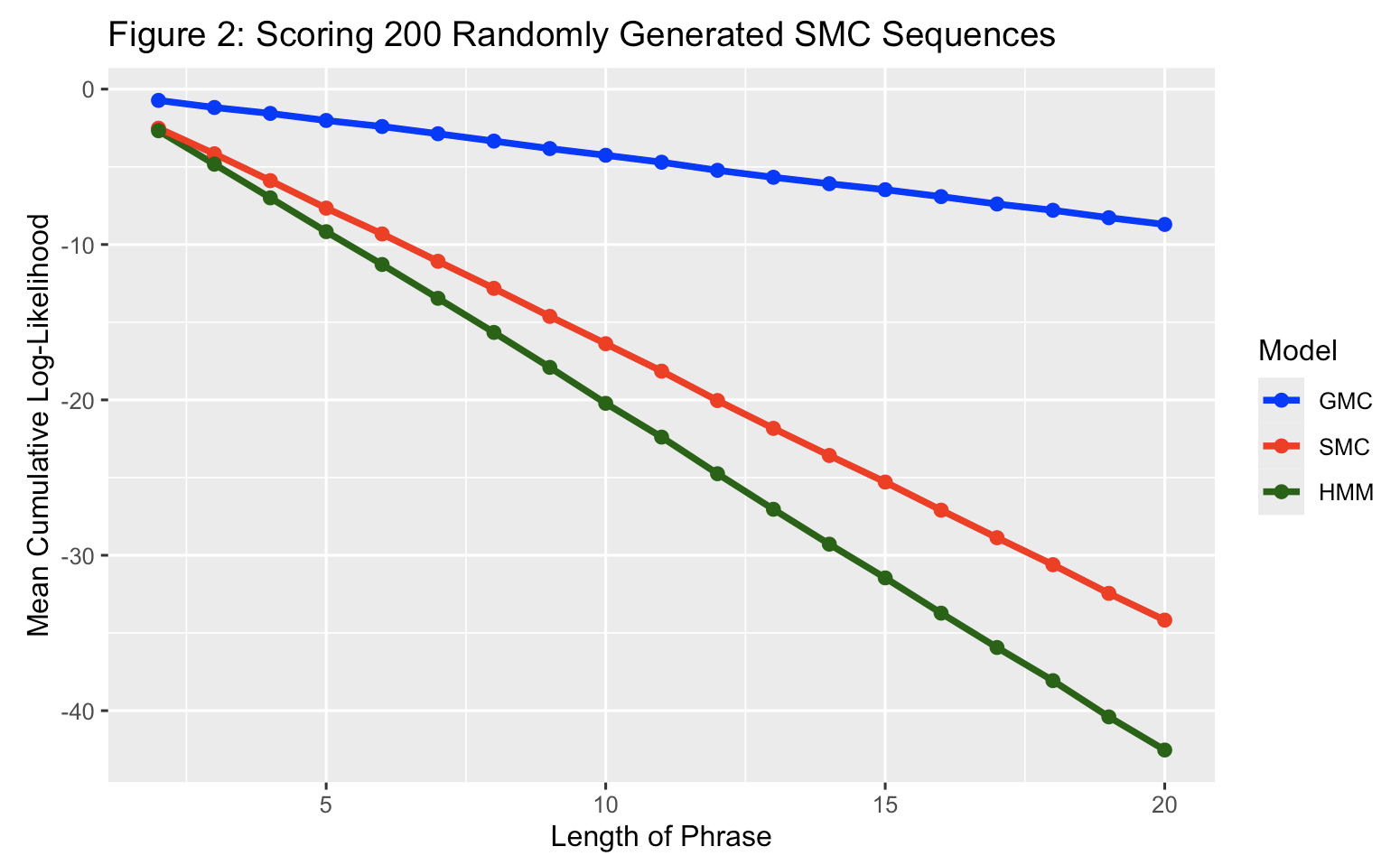
Figure 2: SMC Simulation
Research on computing mean hitting times for musical cadences and the entropy of chord sequences generated by the GMC using a periodic guide is currently ongoing.
TV Game Shows
The game show Lucky 13 differs from other television game shows in that contestants are required to place a bet on their own knowledge of trivia by selecting a range that contains the number of questions that they answered correctly. We present a model for this game show using binomial random variables and generate tables outlining the optimal range the player should select based on maximization of two different utility functions. After analyzing the decisions made by some actual contestants on this show, we present a numerical simulation for how many questions an average player is expected to answer correctly based on question categories observed for twelve sample contestants. This is ongoing work with Prof. Daniel Conus at Lehigh University.